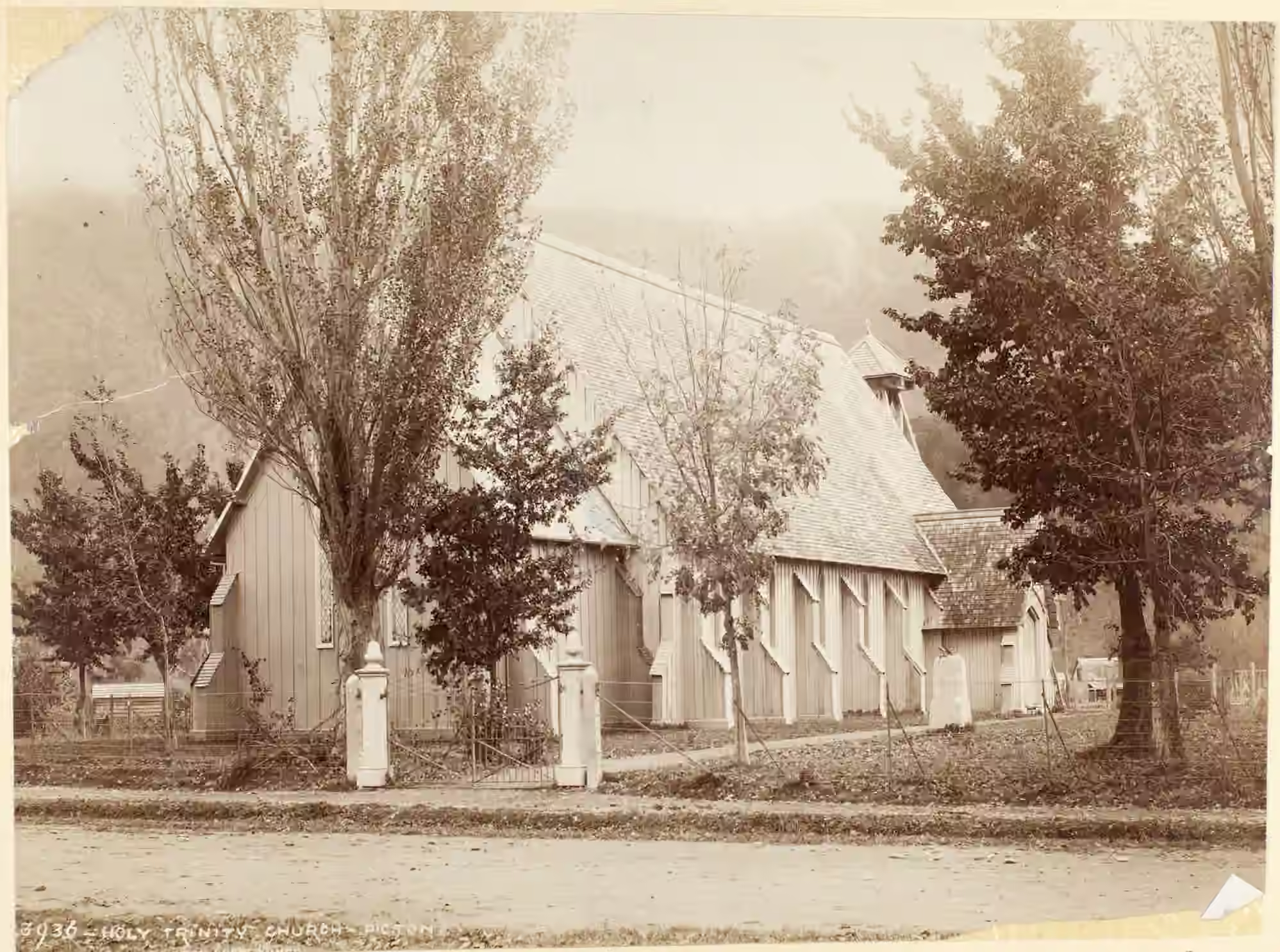
Holy Trinity Church stands as an enduring heritage landmark in Picton. Established during the early colonial era, the parish has anchored the spiritual and social development of the maritime community since the nineteenth century. The stone church structure contains significant historical features, while the surrounding grounds protect a rare nineteenth-century sundial that represents a period of regional political transition.
Listen to Full Article
The Early Timber Community Hub
The Bishop of Nelson opened the first wooden Holy Trinity church building on 31 May 1863 under Bishop Hobhouse and Reverend Thomas Tudor.1 The initial timber structure marked an important milestone as the settlement grew, providing a central venue for local worship and gatherings.1 The parish officially celebrated its 150th anniversary on 31 May 2013.1
The Provincial Capital Dispute and the Town Clock
During the early 1860s, Picton served as the capital of Marlborough Province, housing the regional government offices and the sole public town clock situated at the Provincial Offices.2 A political struggle culminated in 1865 when authorities officially shifted the capital status to Blenheim.2 Government workers removed all administrative records, furniture, and the prized town clock on 10 November 1865 to adorn the new council building in Blenheim.2
The removal of the clock left Picton without an official timepiece for a number of years, creating a strong desire among local residents to secure a permanent replacement.2
The Troughton & Simms Sundial
To restore local pride and provide Picton with an official public time reference, regional representative Arthur Penrose Seymour purchased a specialised brass sundial from London instrument makers Troughton & Simms in 1871.2 Workers installed the timepiece on an octagonal pillar in the churchyards in 1872.2
The community placed the instrument within the consecrated grounds of Holy Trinity Church to protect it from ever being removed.2 The brass dial plate features an eight-pointed compass rose and equation-of-time scales engraved for a precise local latitude of 41°17'30" South.2
During a visit by HMS Wallaroo, the ship's captain, Captain Graham, and his officers checked the sundial against the ship's chronometers and found it to be correctly set.2
Vandals broke and removed the sundial's shadow arm in 1987.2 Parishioners successfully funded a restoration in 1989, relying on original archival photographs as a reference point.2 The sundial holds a Category 2 Historic Place designation under Heritage New Zealand.2
The 1959 Stone Reconstruction and Heritage Legacy
The original wooden Holy Trinity Church, Picton, later replaced by the stone church opened in 1959.Photo: Burton Brothers / Te Papa Collections Online, O.030188.
The original wooden church building was replaced with the opening of a new stone church in 1959.1 The building became debt-free and was consecrated ten years later in 1969.1
Additionally, the Holy Trinity Church Hall continues to serve as a venue steeped in history and charm, hosting community events, gatherings, and celebrations in Picton.3 The church building and its historic 1872 timekeeping monument continue to anchor the cultural and spiritual heritage of the region.2,3
Heritage New Zealand Pouhere Taonga, "Sundial", List No. 1543, heritage.org.nz
The Community, "Holy Trinity Church Hall in Picton, Marlborough", thecommunity.co.nz
Copyright, Disclaimers, and Acknowledgements
Infobox image: North side of the stone Holy Trinity Church, Picton. Photo: Aaron Goodwin. Released into the public domain.
Inline image: The original wooden Holy Trinity Church, Picton, later replaced by the stone church opened in 1959. Photograph by Burton Brothers. Sourced from Te Papa Collections Online, O.030188. Albumen silver photograph.
While every effort is made to maintain accurate and up-to-date citations, Tracing Marlborough/Goodwin & Associates accepts no responsibility for content changes, modifications, or removals on external third-party sources. If you identify inaccurate details, missing context, or information requiring correction, please contact us. Goodwin & Associates asserts no ownership or proprietary rights over any third-party image, video, or media assets utilised within the editorial content of this page, excluding the company's proprietary website logos, marks, and branding. Any exceptions to this policy will be clearly identified via explicit copyright notices, footnotes, or disclaimers on the relevant page. Because a mix of public domain and protected material exists across our archives, please verify rights independently before reusing any image or asset. Additional details are available in our Terms and Conditions.