


Early Rail Development and the Foreshore Station
Waitohi was originally inhabited by Te Āti Awa until its purchase in 1850 under the public works initiatives of Colonial Treasurer Julius Vogel.1,2,3 British contractor Alex Brogden began construction on the line connecting Picton and Blenheim in July 1872.2 Navvies faced difficult geography, constructing a large timber viaduct at the Elevation that required secondary pusher engines for heavy freight trains over six hundred tonnes.2
The original timber station opened on 12 October 1875 along the foreshore below London Quay, with the rail line officially opening on 17 November 1875 during a provincial holiday.1,2 The foreshore platform featured penny-in-the-slot toilets built beneath the London Quay footpath.2 Until the Ōpaoa River bridge was completed in 1880, trains terminated prior to Blenheim, requiring goods to be transferred across the waterway.2
Construction and Design of the 1914 Troup Station
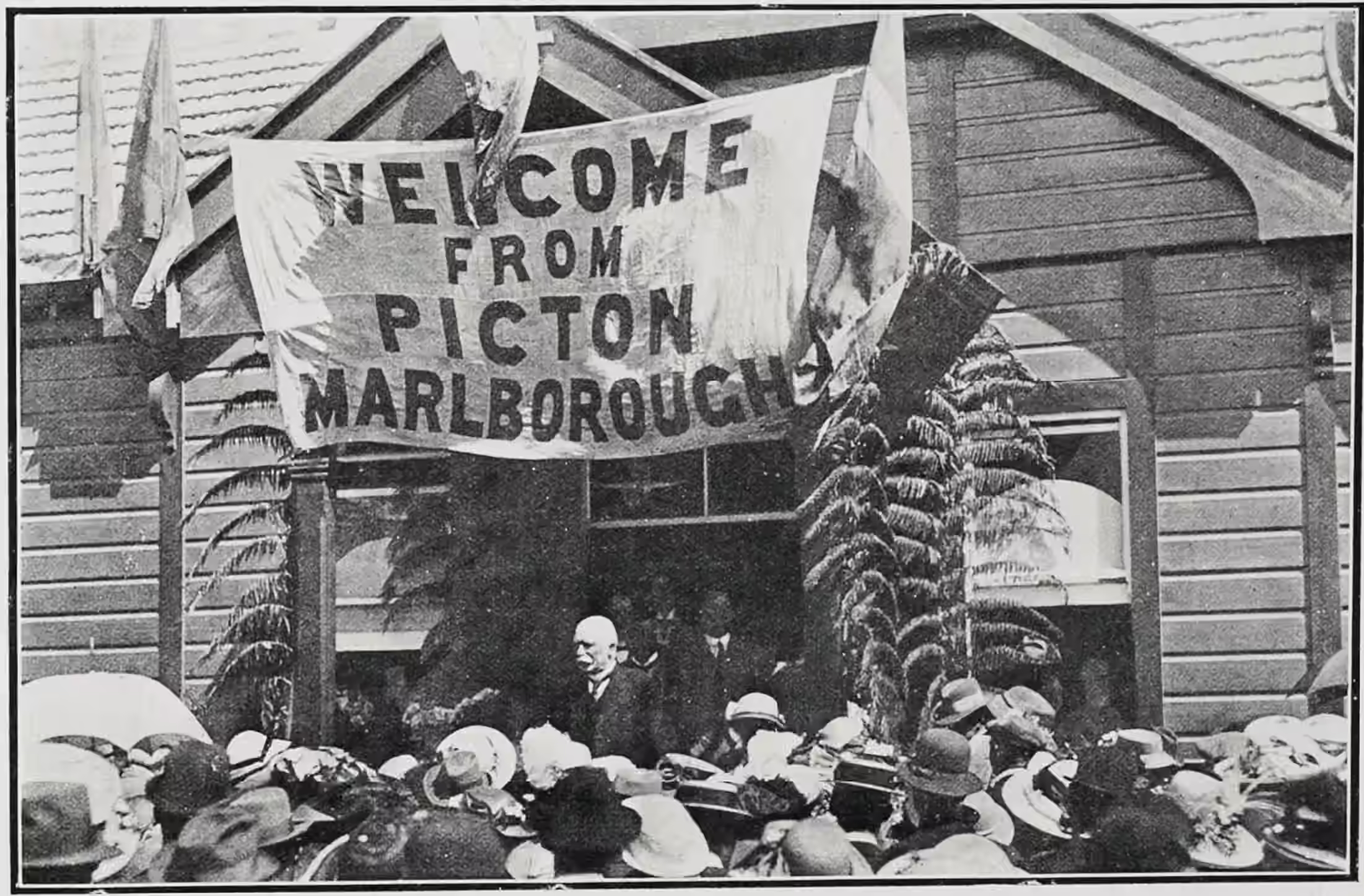
As port operations expanded at Waitohi Wharf, the original foreshore site proved too restricted for growing traffic.1,2 Land reclaimed from Kaiana Lagoon was selected for a replacement building, allowing the old station structure to be moved to the wharf for wharfinger accommodation and freeing the foreshore site for a future war memorial.2 On 11 March 1914, Prime Minister William Ferguson Massey officially opened the new station building.1,2
Designed under New Zealand Railways Chief Draughtsman Sir George Alexander Troup, the single-storey timber building became an example of Edwardian railway architecture.1,4 The station features a Marseille tile roof, Tudor-esque stickwork, bay windows, shaped bargeboards, and a platform canopy supported by railway iron posts.1
Roll-on-Roll-off Ferries and Modern Operations
Traffic through the station increased significantly following the August 1962 introduction of the roll-on-roll-off rail ferry service using the GMV Aramoana.1,3 Picton became the southern terminus for inter-island rail and passenger transit, while the South Island Main Trunk connected the port with Christchurch following its completion in 1945.1,2,3
Beyond its freight and passenger capacity, the station historically served as a vital social link, handling holiday crowds of up to two thousand two hundred arrivals on peak days and providing daily transit for students travelling to Blenheim secondary schools.1 Serving as a regional mail transit point and operational base, the station precinct also influenced local urban development, allowing the original foreshore land to be converted into a public reserve in 1918 following the railway line's relocation.1,4
Since the early 1990s, the interior of the station has undergone commercial remodelling, accommodating local businesses including Subway while retaining its heritage status as a Category 2 Historic Place under Heritage New Zealand Pouhere Taonga.1,4 The building continues to function as an active stop for the Coastal Pacific passenger train.1