

Tracing Marlborough - Home

Seymour Square

Seymour Square is the formal, civic, and ceremonial heart of Blenheim. Set aside during the town's very first survey, this beautifully manicured public space has evolved into a place of immense community significance. Dominated by the iconic Marlborough War Memorial Clock Tower, it is both a place of solemn remembrance and an active hub for civic events and public enjoyment. With its formal gardens, historic fountain, and central location, Seymour Square serves as the town's front lawn - a symbol of civic pride and a focal point for the Marlborough community.

Listen to Full Article

The Founding of a Town Centre

The origins of Seymour Square date back to 1857, when an area of approximately one hectare was set aside as a public reserve in the developing settlement of Blenheim, then commonly known as 'The Beaver'. The square was named after Henry Seymour, an early European landowner who, together with his son-in-law A. G. Fell, drew land sections in the Wairau in 1848, in the area where Blenheim now stands.1,2 In its early years, the reserve was used for recreational activities, including cricket and rugby, before more formal landscaping began in the early twentieth century.1

A Place of Remembrance: The War Memorial

Following the First World War, Marlborough residents debated how and where to commemorate those from the province who had died in the conflict. After several years of disagreement, Seymour Square was selected as the site for the provincial memorial in the 1920s. The project was funded through public subscriptions, with stone collected from different parts of Marlborough to represent the wider province.3 The War Memorial Clock Tower was designed by architect Roger Bacon and officially unveiled on 4 February 1928. Rising approximately 16 metres above the square, it commemorates the Marlborough residents who lost their lives in the First World War.3,4,5 The tower remains Marlborough's principal First World War memorial and an important focus for civic remembrance and Anzac Day commemorations.3,6

Landscaping a Civic Space
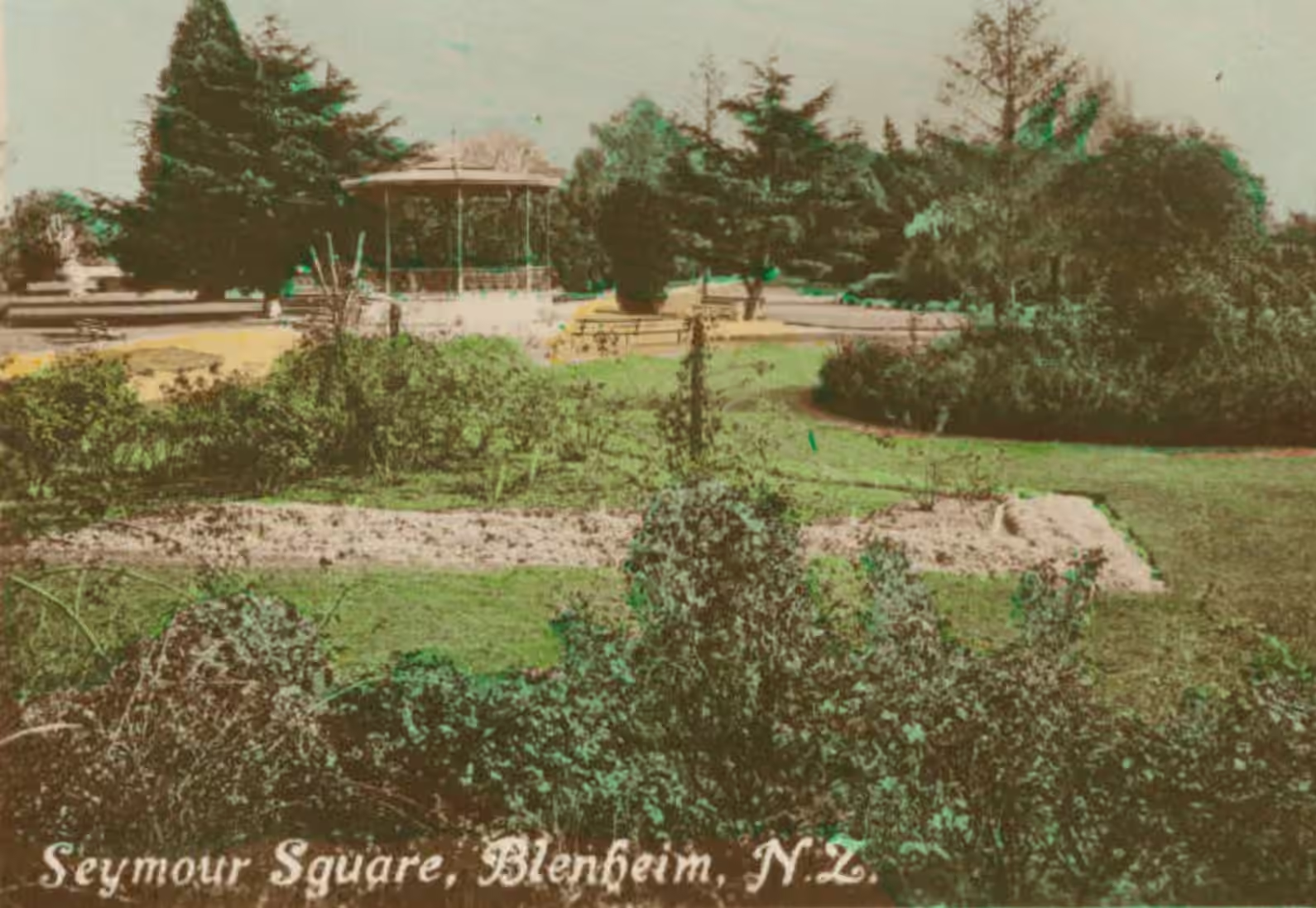
Handcoloured photograph of the gardens and band rotunda in Seymour Square, Blenheim.
The gardens and band rotunda in Seymour Square, Blenheim, photographed in the 1930s.Photographer unknown / Auckland Libraries Heritage Collections 879-48.

Over the decades, Seymour Square developed from an open recreational reserve into a formal civic garden. Today, its lawns, pathways, flowerbeds and seasonal planting displays make it one of Blenheim's prominent public gardens.1 Another important feature is the Second World War memorial fountain, which replaced an earlier band rotunda and was unveiled in 1953. The fountain commemorates those who served during the Second World War, complementing the First World War memorial clock tower nearby.1,6 Together, the gardens and memorials give Seymour Square its distinctive character as a place of recreation, remembrance and civic pride.

The Community's Gathering Place

While it is a place of history and remembrance, Seymour Square remains an active part of the Blenheim community. Its formal gardens provide a setting for everyday recreation, while the memorials continue to serve as focal points for commemorative services and civic gatherings. The square also hosts community garden events and remains a prominent feature of central Blenheim.1,6 Its continuing use reflects the enduring importance of this public space to Marlborough's civic life.

Sources

  1. New Zealand Garden Trust. Seymour Square. History of the reserve, early recreation, gardens and memorial fountain.
  2. Scholefield, G. H. A Dictionary of New Zealand Biography, Volume II. Entry for Henry Seymour.
  3. Heritage New Zealand Pouhere Taonga. War Memorial and Clock Tower. Historic Place Category 1, List No. 243.
  4. Manatū Taonga - Ministry for Culture and Heritage. Blenheim First World War Memorial. Memorial record and unveiling date.
  5. Te Ara - The Encyclopedia of New Zealand. War Memorial Clock Tower, Blenheim. Tower height, construction and memorial significance.
  6. Marlborough War Memorial Heritage Trail. Blenheim War Memorial Clock Tower and Second World War Memorial Fountain. History of the memorials and their continuing commemorative role.

Copyright, Disclaimers, and Acknowledgements

Infobox image: Seymour Square, Blenheim, depicted on a colour postcard produced between 1904 and 1915. Muir & Moodie / Te Papa Collections Online, PS.002190/02. Colour postcard.

Inline image: The gardens and band rotunda in Seymour Square, Blenheim, photographed in the 1930s. Photographer unknown / Auckland Libraries Heritage Collections 879-48.

While every effort is made to maintain accurate and up-to-date citations, Tracing Marlborough/Goodwin & Associates accepts no responsibility for content changes, modifications, or removals on external third-party sources. If you identify inaccurate details, missing context, or information requiring correction, please contact us. Goodwin & Associates asserts no ownership or proprietary rights over any third-party image, video, or media assets utilised within the editorial content of this page, excluding the company's proprietary website logos, marks, and branding. Any exceptions to this policy will be clearly identified via explicit copyright notices, footnotes, or disclaimers on the relevant page. Because a mix of public domain and protected material exists across our archives, please verify rights independently before reusing any image or asset. Additional details are available in our Terms and Conditions.